7 Mistakes Organizations Make When Running Board Elections
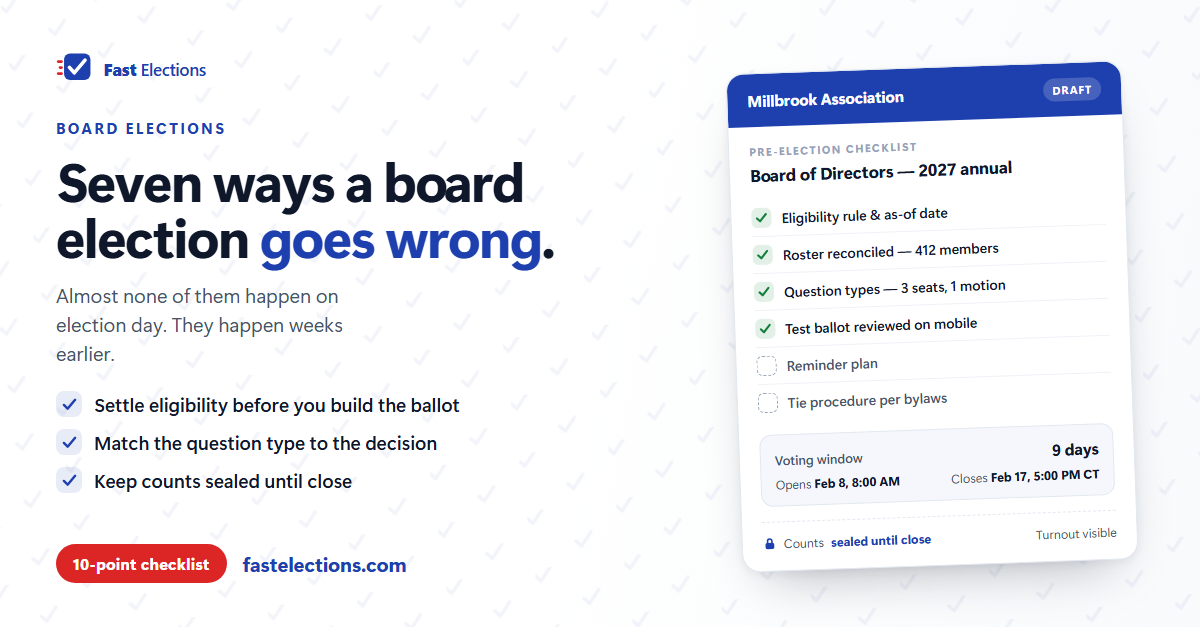
Board elections rarely fail dramatically. They fail quietly — a roster nobody reconciled, a question worded so that two people read it differently, a close time that moved because the meeting ran long. By the time anyone objects, the ballots are counted and the fix is expensive.
The encouraging part: the same handful of mistakes account for most of it, and all of them are preventable weeks in advance. Seven worth checking against your own process, whether you vote on paper or online.
1. Building the ballot before settling the roster
This is the big one, and it's almost universal. The interesting work — who's running, how the motion is worded — happens first, and "get the member list" becomes a task for the week before voting opens. That's when someone discovers three duplicate records, a dozen dead addresses, and a genuine question about whether members in arrears may vote.
Eligibility is a governance decision, not a data-entry task. Settle it first, in writing: who may vote, as of what date, under which provision of your bylaws. A roster you can defend afterward is worth more than a ballot that looks nice.
2. Using the wrong question type for the decision
A three-seat board election run as "vote for one" produces a result that doesn't match the office being filled. Ranked choice sounds sophisticated right up until you have to explain the elimination rounds to a membership that expected a simple count.
Match the mechanism to the decision before you write a single option:
- One seat — a straightforward choose-one vote.
- Several seats at once — choose-N: voters cast as many votes as there are seats, and the top N win.
- Support across several acceptable options — approval voting, where members approve as many as they like.
- A majority winner among three or more candidates — ranked choice, if your bylaws permit it and you can explain it in two sentences.
- A bylaws change, a budget, any up-or-down question — a yes/no/abstain motion.
Then check the rule your bylaws actually specify. Plurality and majority are not the same thing, and the difference decides real elections.
3. Never looking at the ballot the way a voter sees it
Administrators review the ballot in the tool they built it in. Voters see something else entirely — an email, on a phone, with no context and no patience. Typos in candidate names, a confusing question order, instructions that made sense only to their author: these are found by testing, not by proofreading.
Send yourself a test ballot and go through it on a phone, start to finish. Then send it to a board member who wasn't involved in building it. The second reader finds what the first cannot.
4. Treating the voting window as an afterthought
Two failures live here. The window is too short — three days spanning a holiday weekend is a turnout problem you created yourself. Or the closing time is soft: the meeting runs long, someone accepts a ballot at the door "since they're already here," and the close time in the minutes no longer matches what happened.
Pick a window of at least a week, publish the exact closing time and the timezone that governs it, and let a clock enforce it rather than a person. An election that closes itself is one fewer thing to argue about.
5. Finding out about turnout when it's too late to act
Missing quorum is the most expensive outcome in a membership election, because it means running the whole thing again. Yet most organizations learn where turnout stands on the final day.
Watch participation while voting is open — who has voted, who hasn't, whose invitation never arrived — and act with three or four days left, not three hours. Undeliverable addresses deserve particular attention: a bounce is documented evidence that notice didn't reach a member, and it's fixable while the election is still running.
6. Watching the count while voting is open
Turnout is safe to watch. The tally is not. A running count that any organizer can see leaks — into a hallway conversation, a text message, a "we're going to need more votes" email — and once members can see which way a vote is trending, they vote differently. That isn't a secret ballot anymore, whatever the bylaws call it.
Keep counts sealed until voting closes, for everyone including the board. If your process can't guarantee that, it's a weakness worth naming before someone else names it for you.
7. Ending with a number instead of a record
The vote is announced, the meeting adjourns, and three weeks later a member asks how the count was verified and whether their ballot was included. If the answer lives in a box in someone's garage, or in three volunteers' memory, the board has a problem it can't solve retroactively.
Finish with an artifact: who was eligible, who participated, when voting opened and closed, what the totals were, and some way for a member to confirm their own ballot was counted without revealing how they voted. Assemble it while the election is happening. Nobody reconstructs it well afterward.
The pre-election checklist
Worth saving, or sending to whoever runs your next vote:
- Eligibility rule in writing, with an as-of date, before anything else.
- Roster reconciled — duplicates resolved, addresses current, arrears settled.
- Question type matched to each decision and to the majority rule your bylaws require.
- Candidate names and option text proofread by someone who didn't write them.
- Test ballot completed on a phone by at least two people.
- Window of a week or more, avoiding holidays, with a published close time and timezone.
- Reminder plan set before voting opens, not improvised during it.
- Counts sealed until close — including from the board.
- Tie procedure confirmed in your bylaws in advance. Ties happen.
- Records retained per your retention rule: eligibility list, participation log, results.
Where Fast Elections fits
Most of that list is judgment, and no software supplies it. The mechanical half is what an election tool should carry: choose-one and choose-N, approval, ranked choice, and yes/no/abstain motion questions on the same ballot; a test ballot you can send yourself as often as you like before launch, which can never be cast; scheduled open and close times in the timezone you name, so a clock closes the election rather than a person; live turnout while the tally stays sealed until close; automatic reminders to non-voters 72 and 24 hours before the end; and a bounced-address list you can fix mid-election.
When voting closes, results compute immediately, and each voter's receipt code — tied to no identity — is published alongside them, so a member can confirm their ballot was counted without anyone learning how they voted. Ties are reported plainly rather than auto-resolved: "Tie between [options] — resolve per your bylaws." That last part is deliberate: whether electronic ballots are permitted for your vote, what your quorum is, and how a tie gets broken are your governing documents' business, not a vendor's.
One note on the free tier: it sends no email at all. Every voter still gets a single-use voting link — you deliver those links yourself. Invitations, automatic reminders, and bounce handling start at the $5 tier.
If your board's next election is coming up, you can build it in Fast Elections for free and see exactly what your voters will experience before paying anything.