Six Reasons HOA Boards Are Moving Elections Online
A homeowner emails the board three weeks after the annual meeting. They want to know how the count was verified. Whether their own ballot was included. Whether the owner of three units really got three votes, and whether anyone checked that the person who dropped off four envelopes was entitled to.
These are reasonable questions. The uncomfortable part is how often a board can't answer them — not because anything went wrong, but because a paper election held in a clubhouse leaves behind almost no evidence that anything went right. The ballots are in a box. The sign-in sheet is in someone's car. The tally was done by three volunteers at 9pm who have all gone home.
Compliance, in practice, is not about intent. It's about what you can demonstrate afterward. That's the specific thing online election software is good at, and it's why more associations run their annual votes this way each year. Six reasons that come up again and again:
1. The ballot is secret by construction, not by promise
Every set of governing documents says the ballot is secret. Paper makes that a matter of custody: whoever handles the envelopes could, in principle, match a signature to a vote. Nobody usually does. The point is that an owner has no way to know that.
Well-built election software removes the possibility rather than discouraging it. In Fast Elections, a cast ballot carries no reference at all to the voter who submitted it — no name, no email, no account link. There is no admin screen, database query, or export anywhere in the product that connects a person to their choices, which means the board can't see how anyone voted and neither can we. Even the timing is blunted: ballot timestamps are rounded to the hour so cast order can't be used to infer who voted which way.
That's a stronger claim than "we keep it confidential," and it's the one that ends the argument.
2. Eligibility is settled before the vote, not during it
Most disputes trace back to the roster, not the ballot. Who was entitled to vote. Whether the delinquent account was excluded correctly. Whether a unit that changed hands in March votes under the old owner or the new one.
Running the election from an explicit voter list forces that work forward, where it belongs. You build the roster, you review it, and each owner of record gets their own unique voting link. One link, one ballot — once it's used, it can't be used again. Nobody votes twice, nobody votes who isn't on the list, and the list itself is a document you can produce later.
3. Weighted voting stops being hand math
Plenty of associations don't vote one-owner-one-vote. They vote by units owned, by percentage interest, by square footage. Doing that on paper means someone reconciling a tally sheet against an ownership schedule at the end of a long night, and every arithmetic slip is a potential challenge.
Software carries the weight with the ballot. Fast Elections takes a weight column straight from your ownership spreadsheet and applies it to every question type, including ranked-choice rounds. Turnout still reports as a count of people, so you can see both numbers — how many owners participated, and how much voting interest was cast.
One honest caveat, because it matters: in a weighted election the ballot has to carry its weight to be counted, and a highly unusual weight can single out a ballot. We flag any weight value held by fewer than ten voters before you launch, so it's a decision you make with your eyes open rather than a surprise.
4. The deadline is enforced by a clock
Notice windows and closing times are where volunteer-run elections quietly fail. The meeting runs long, someone accepts a ballot at the door "since they're already here," and now the close time in the minutes doesn't match what actually happened.
Set an open time, a close time, and the timezone that governs them, and the election opens and closes itself. Invitations go out at the start time without anyone remembering to send them. Voting stops at the end time and results are computed whether or not a single board member is online.
5. You can watch turnout while there's still time to act
Quorum failure is the most expensive outcome in an association election, because it means doing the whole thing again. On paper you find out on the night. Online, the board can see participation as it accumulates — who's been invited, who's voted, whose invitation bounced — while the tally itself stays sealed until close.
That distinction is the useful part. Nobody, including the board, can see a partial count and react to it. But you can see that you're at 41% with four days left, and send the reminder that gets you over the line. Automatic reminders to non-voters, typically at 72 and 24 hours before close, handle most of that without anyone chasing anybody.
Bounced addresses are worth a special mention. A returned invitation is documented evidence that notice didn't reach an owner and that you tried again — which is exactly the sort of thing that becomes hard to reconstruct from a stack of undelivered envelopes.
6. There's a record after the meeting ends
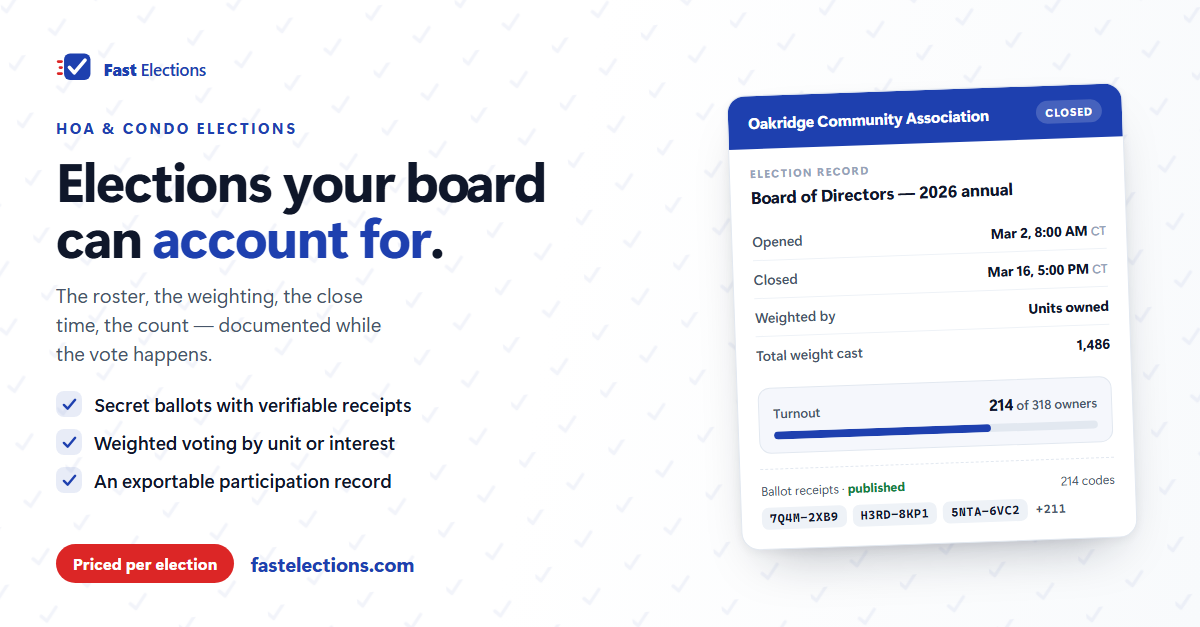
This is the reason that outlasts the others. When voting closes you have a participation log with timestamps you can export as a CSV, results you can publish at a link owners can open without an account, and a receipt code issued to each voter at the moment they cast their ballot. Once results are published, the full list of receipt codes is published alongside them — so an owner can find their own code and confirm their ballot was counted, without revealing to anyone, including the board, how they voted.
That turns the awkward email into a two-line reply. Here is the record. Here is how to check your own.
What software doesn't do
It's worth being straight about the limits, because vendors usually aren't.
Election software doesn't replace your inspector of elections, and it doesn't override your CC&Rs. It doesn't decide whether your state's law and your governing documents permit electronic ballots for the vote you're holding — rules vary considerably by state and by document, and that's a question for your association's counsel or manager before you commit to a method, not after. Fast Elections has no proxy handling and no quorum-rule engine; it gives you accurate turnout numbers, but applying your own quorum definition to them is still the board's job.
None of that changes the underlying point. The parts of an association election that get challenged — secrecy, eligibility, weighting, timing, and proof — are mechanical, and mechanical work is exactly what you should stop asking volunteers to do by hand at 9pm.
If your association's next vote is coming up, Fast Elections runs secret-ballot elections with weighted voting, scheduled open and close times, and verifiable published results, priced per election rather than as a subscription: get started or see how pricing works.