How Multilingual Online Ballots Can Increase Participation in Member Elections
A tenants' association serves a building of two hundred households. The notices taped up in the lobby are in English and Spanish, because the board learned years ago that English-only notices went unread. The spring picnic flyer goes out in three languages.
The annual election ballot goes out in English.
Turnout comes back at its usual level, the usual people win, and at the next meeting someone observes that half the building never seems to take an interest in how the association is run.
Nobody decided to leave those households out. The ballot was simply the one document nobody thought to translate.
An unread ballot looks exactly like apathy
A member who reads English as a second or third language can usually manage a picnic flyer. A ballot is different. It has candidate statements, a motion about the reserve fund, an instruction that says "rank in order of preference," and a warning that the vote can't be changed once it is submitted.
Faced with that, a careful person does the careful thing: they don't vote on what they aren't sure they understood. Or they hand the phone to a son, a daughter or a neighbor and ask what to press — which gets a ballot cast, but it is no longer a private vote and arguably no longer theirs.
From the board's side, both of these are invisible. A ballot that was never opened and a ballot that was opened, puzzled over and closed look identical in the turnout figure. The organization concludes that those members aren't engaged, when the more accurate reading is that it asked them a question in a language they weren't comfortable answering in.
Why paper made this hard, and online makes it cheap
On paper, each language is a separate print run. Someone has to guess how many copies of each to print, work out which household gets which, and then merge the stacks at the count. Most volunteer boards look at that and reasonably decide English will have to do.
Online, the arithmetic changes. One ballot can carry several languages at once. Each voter reads it in theirs, and every vote lands in the same count, because the choices underneath are the same whatever language they were displayed in. The remaining cost is the translation itself, which for a typical board election is a few hundred words.
So the question stops being "can we afford to?" and becomes "will we do it properly?"
What "properly" means
Translate the whole path, not just the questions. The invitation email, the reminder, the instructions, the buttons, the confirmation screen and the results announcement all matter. A member who can't read the subject line of the invitation never reaches your carefully translated ballot.
Let the voter choose. Don't assign a language by surname or by unit number. Offer the languages, open the ballot in a sensible default, and put a visible switcher on it. Plenty of people speak one language at home and prefer to read formal documents in another.
Leave names alone. Candidate names, the organization's name and street names are not vocabulary. Translation tools like to add accents or transliterate them; check that every candidate appears as they spell their own name.
Get a fluent reviewer. Machine translation is a useful first draft and a poor final one. Governance terms — "quorum," "abstain," "special assessment," "at-large" — are exactly where it slips. Ask a member who is fluent to read the ballot through, ideally someone who isn't a candidate.
Decide which text governs. If two versions are ever read differently, the board should already have said which one is the official wording. That belongs in the election notice, and your bylaws or counsel may have a view.
A multilingual ballot checklist worth saving
- Find out which languages you need. Look at what you already translate — notices, newsletters, the languages spoken at meetings — and ask members if you aren't sure.
- Choose a short list you can do well. Two languages translated carefully beat six translated badly.
- Finish the original wording first. Every late edit to the English has to be repeated in every language.
- Write plainly. Short sentences and ordinary words translate better and read better in every language, including the original.
- Translate everything the voter sees, from the invitation subject line to the results email.
- Keep names exactly as written.
- Have a fluent member review each language, and note who did.
- State which version governs in the election notice.
- Record each member's preferred language where you know it, so their emails arrive in it.
- Open a test ballot in every language on a phone before launch. Look for text that was missed and wording that runs off a button.
- Announce the vote in the same languages, through the channels those members actually use.
- Publish the results in them too. The members you worked to include should be able to read how it came out.
Where Fast Elections fits
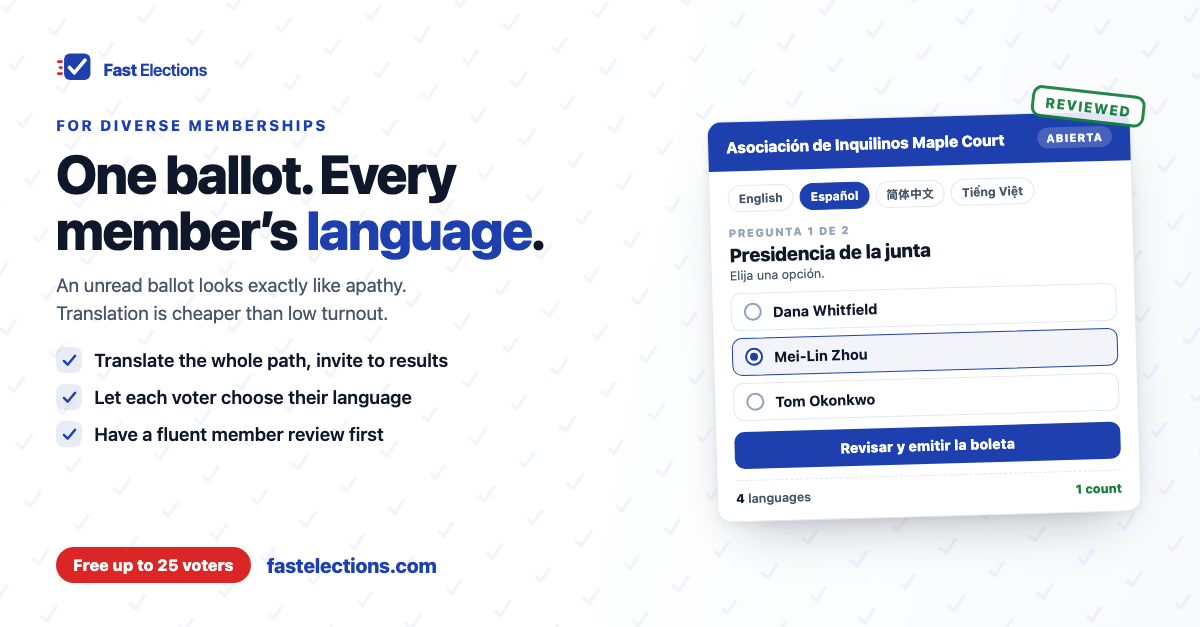
A Fast Elections ballot can run in up to eleven languages at once: English, Spanish, French, Portuguese, German, Italian, Polish, Vietnamese, Simplified Chinese, Tagalog and Japanese. You choose the ones you want while building the election, and the instructions, buttons and confirmation screens are already translated in all of them. What you translate is your own content — the title, questions, options and any custom email text.
You can type those translations in yourself at no cost, with a counter showing how much of each language is done. Or an optional $5 add-on per election machine-translates whatever you haven't filled in, and leaves anything you have already entered alone. The first time you use it, the product tells you what this article does: have a fluent speaker review it. Every field stays editable until launch.
Each voter's ballot opens in their browser's language when it is one you offer, with a switcher on the ballot and results pages. You can also set a language per voter on the roster, which decides the language of their invitation, reminder and results emails on the paid tiers. Anything left untranslated falls back to your original wording rather than showing a blank, and the launch step warns you about what's missing in each language.
One thing to plan around: the language list and the ballot translations lock at launch, along with the questions. Translation is preparation, not something to patch on day two.
Fast Elections won't tell you whether a translation is good. That is still a job for a person who reads the language.
If you have an election coming up, you can build it in Fast Elections for free — up to 25 voters, no credit card — add a second language, open the ballot on your own phone, and see exactly what your voters will experience before paying anything: fastelections.com