"How to Handle Ranked-Choice, Approval, Yes/No, and Plurality Voting Online"
Three candidates ran for president of the association. The winner got 41% of the vote. Within a week, supporters of the other two were asking whether that was really a mandate, and the board was rereading the bylaws to find out whether "elected by a majority" meant what everyone had assumed.
Nothing went wrong with the ballots. Every vote was counted correctly. The problem was the voting method, and nobody had chosen it. It was simply the way the organization had always voted.
Why the method deserves a decision
On paper, almost every organization defaults to "vote for one," because hand-counting anything else is miserable. Nobody wants to sort ranked ballots into piles on a Saturday afternoon.
Online, the counting cost disappears. That means you can pick the method that actually fits the question — but it also means the choice is now yours to make, deliberately and before voting opens. A method chosen after the results come in isn't a method. It's a dispute.
Here are the four you'll see most often.
1. Plurality: choose one, or choose N
How it works: Each voter picks one option. The option with the most votes wins. For a multi-seat race — say, three open board seats — voters choose up to three, and the top three vote-getters win.
Good for: Two-candidate races, uncontested slates, and multi-seat board elections. It's the method everyone already understands.
Watch out for: With three or more candidates, the winner may have far less than half the vote, as in the example above. If your bylaws say "majority," plurality may not satisfy them. For multi-seat races, make sure the number of choices matches the number of seats; a three-seat election run as "vote for one" produces a result that doesn't match the office being filled.
2. Approval: approve as many as you like
How it works: Voters mark every option they find acceptable. Each approval counts equally, and the option with the most approvals wins.
Good for: Choosing among several reasonable options where you want broad support rather than a passionate minority — a meeting date, a shortlist of vendors, a new name for the newsletter, a pool of committee volunteers.
Watch out for: Approval measures acceptability, not intensity. A voter's favorite and their "fine, I guess" count the same. It's also unfamiliar to many members, so the ballot instructions need to say plainly that marking more than one is allowed. And because few bylaws mention it, check before using it to elect officers.
3. Ranked choice (instant runoff)
How it works: Voters rank the options in order of preference. If no option has a majority of first choices, the last-place option is eliminated and those ballots move to each voter's next choice. That repeats until one option has a majority of the ballots still in play.
Good for: A single seat with three or more candidates, where you want a majority winner without holding a second runoff election weeks later.
Watch out for: Three things. First, voters who rank only one or two options may have their ballot "exhausted" before the final round, so the winning majority is a majority of active ballots, not of everyone who voted — explain that up front. Second, instant runoff fills one seat; for multi-seat races, use choose-N or approval instead. Third, members can't trust what they can't follow, so publish every round: who was eliminated and where those votes went.
4. Motions: yes, no, or abstain
How it works: One up-or-down question. Voters choose yes, no, or abstain.
Good for: Bylaw amendments, budgets, special assessments, dues changes, ratifying a contract — anything that is a decision rather than a selection.
Watch out for: The threshold. "Passes by a majority" can mean a majority of votes cast, a majority of members present, or a majority of all members, and some actions require two-thirds. Decide in advance how abstentions are treated; under many bylaws they count toward neither side, but that's your governing documents' call, not your software's. And put the full text of the motion on the ballot, written neutrally.
A checklist before you build the ballot
Worth saving and sharing with your election committee:
- Read the bylaws first. Note the method and the threshold they require for each kind of vote. If they're silent, have the board adopt a method in writing before nominations close.
- Match the method to the question. One contested seat: plurality or ranked choice. Several seats: choose N. Several acceptable options: approval. A decision: a motion.
- Set the seat count. For multi-seat races, confirm how many seats are open and whether members may vote for fewer.
- Decide the tie rule now. Coin flip, runoff, or board vote — written down before voting opens, not invented afterward.
- Define "passes." For every motion, write down the threshold and how abstentions are treated.
- Write one-sentence instructions. "Rank as many as you like; you don't have to rank everyone." "Mark every option you'd accept."
- Explain the count in the election notice. Members should know how the winner will be determined before they vote.
- Test the ballot yourself. Fill it out as a voter would, on a phone, before anyone else sees it.
- Lock the ballot when voting opens. Changing a question or its method mid-vote invalidates every ballot already cast.
- Publish full results. Counts for every option, ranked-choice rounds, abstentions, and turnout.
Where Fast Elections fits
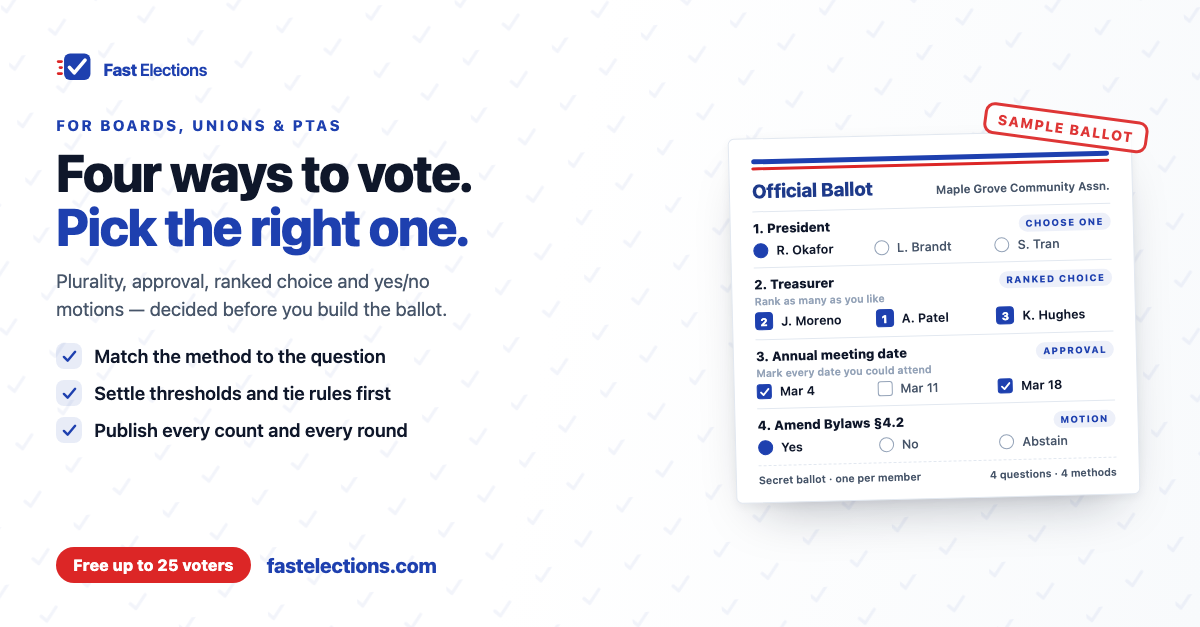
Fast Elections lets you choose the method question by question, so one ballot can hold a ranked-choice race for president, a three-seat choose-N board election, an approval question for next year's meeting dates, and a yes/no/abstain motion on a bylaw amendment. Write-ins can be allowed on plurality and approval questions, and weighted voting — for organizations that vote by units or shares — works with every type.
The count follows the method automatically when the election closes. Ranked-choice results show every instant-runoff round, including who was eliminated and how many ballots were exhausted. Motions report yes, no and abstain separately; the built-in pass rule is a simple majority of yes plus no, so if your bylaws set a different threshold, such as two-thirds, judge the result against the published counts. Ties are reported plainly — "resolve per your bylaws" — and never broken by coin flip or timestamp.
The ballot locks at launch, and you can send yourself test ballots beforehand to see exactly what each question looks like to a voter. It doesn't interpret your bylaws for you; it gives the people who do a ballot and a count that match the decision they made.
If you have an election coming up, you can build it in Fast Elections for free — up to 25 voters, no credit card — try each question type on a test ballot, and see exactly what your voters will experience before paying anything: fastelections.com