Paper Ballots vs. Online Voting: What Does an Election Really Cost?
Ask a board what its annual election costs and you'll usually get a shrug, or a number that covers the printing. The rest of it is scattered — a postage line in one month, a copy-shop receipt in another, and a Saturday afternoon that never appears in any ledger because volunteers did it.
That's not an accounting failure. It's just how paper elections bill you: in pieces, from several directions, with the largest costs invisible. Before deciding whether to keep mailing ballots, it's worth assembling the whole number once.
Here's how to do that, and what to compare it against.
The five buckets
Nearly every paper election cost falls into one of five categories. Four of them are easy to underestimate.
1. Materials. Ballots, instruction sheets, an outer envelope, and — if your governing documents require a secret ballot by mail — an inner secrecy envelope and a return envelope. Small per unit, and multiplied by every eligible member, not every voter.
2. Postage. The line that surprises people. You pay to mail every eligible member, whether or not they vote. If you prepay return postage, you may pay twice for the same member. At any realistic stamp price, this is usually the largest cash item in the election.
3. Labor. Assembly, mailing, tracking returns, verifying eligibility, opening envelopes, counting, recounting when the first two counts disagree, and writing it all into the minutes. Volunteer time is free in the budget and not free in reality — it's the reason nobody wants the election committee, and the reason the same three people do it every year.
4. The re-run. The single most expensive outcome in a membership election is missing quorum, because it means doing everything above a second time. If your turnout runs anywhere near your quorum threshold, this isn't a tail risk — it's a cost with a probability attached.
5. Disputes. Rarely priced, occasionally enormous. A challenged count means finding the ballots, reconstructing who was eligible, and demonstrating that the process was followed. On paper, most of that evidence went home in someone's car.
Do the arithmetic once
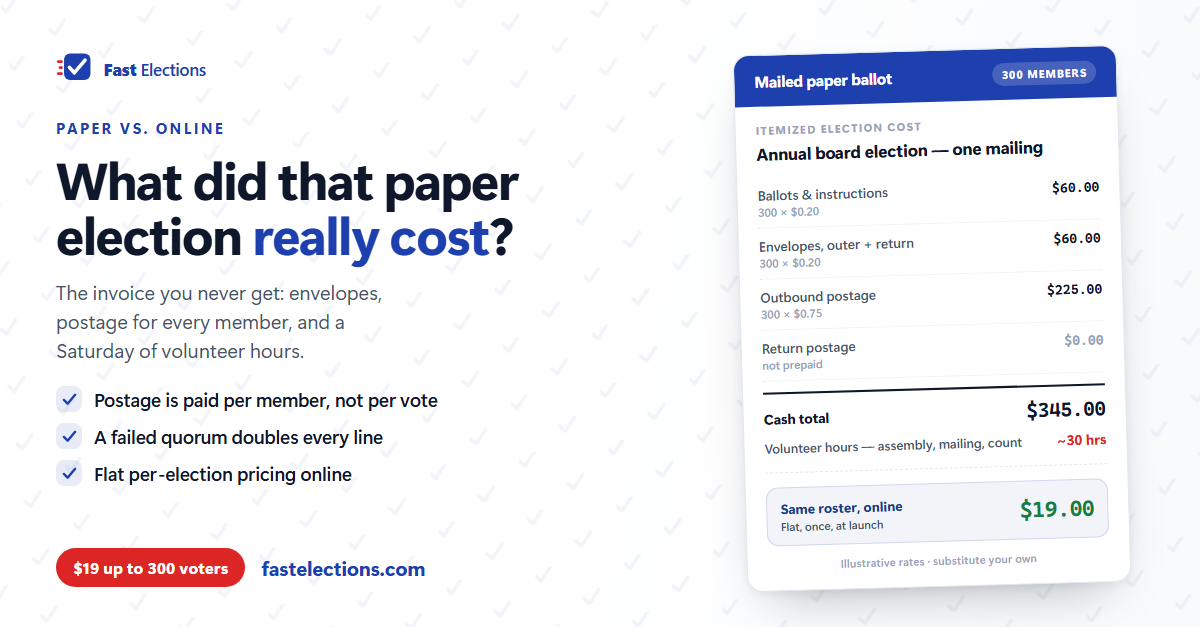
Take your own roster and fill this in. Illustrative rates below for a 300-member association mailing one ballot per member — substitute your real numbers, they'll differ:
| Line item | Example |
|---|---|
| Ballots and instructions, printed | 300 × $0.20 = $60 |
| Envelopes, outer + return | 300 × $0.20 = $60 |
| Outbound postage | 300 × $0.75 = $225 |
| Return postage (not prepaid) | $0 |
| Cash total | $345 |
| Volunteer hours (assembly, mailing, count) | ~30 hours |
Now divide by the ballots you actually got back. If 102 of 300 members returned a ballot — a 34% turnout, which is a perfectly ordinary result for a mailed association election — that election cost about $3.38 per ballot received, plus thirty hours. Two-thirds of the postage bought nothing at all.
That per-ballot number is the one to bring to the board. It's the honest measure, and it gets worse, not better, as turnout falls.
What changes when the ballot is electronic
Two things, and only one of them is the price.
The obvious one: online election pricing is generally flat per election and small relative to the postage it replaces. Nothing scales with turnout, because there's no per-piece cost to scale.
The one that matters more: the labor collapses. There's no assembly, no return tracking, no envelope-opening evening, and no count — the tally is arithmetic performed the moment voting closes. The work that remains is the work that was always the valuable part: getting the voter roster right and writing a clear ballot.
There are second-order savings too, and they're worth naming because they're where the quorum risk actually lives. Reminders to people who haven't voted cost nothing to send, so turnout tends to be higher. Undeliverable addresses come back as a bounce you can fix during the voting window, instead of an envelope that vanished silently into a wrong address. And when someone questions the result, you have a participation record and published totals rather than a box and three people's memories.
Be honest about what online voting doesn't remove
Any vendor who tells you the switch is free is selling. Three real costs stay on your side of the line:
- Email addresses. This is the actual migration cost. If you have current email addresses for 60% of your members, closing that gap is a project — and it's a project worth doing regardless of how you vote.
- An accessible path for members who need one. Some members won't vote online. Plan for how they participate before you promise a fully electronic election, not after someone complains.
- Your bylaws and your state's law. Whether electronic ballots are permitted for the vote you're holding is a legal question, and the answer varies by state and by document. Ask your counsel or your manager first. No software answers this for you.
The checklist
Cost your next election in about ten minutes:
- Count eligible members — that's your multiplier, not your expected turnout.
- Price materials per member: ballot, instructions, envelopes.
- Price outbound postage per member. Add return postage if you prepay it.
- Estimate volunteer hours honestly: assembly, mailing, tracking, counting, minutes.
- Divide the cash total by ballots actually returned last time. That's your real per-ballot cost.
- Multiply the whole thing by your realistic probability of missing quorum and re-running it.
- Compare against a flat online price for the same roster — and against the hours you get back.
Where Fast Elections fits
Fast Elections is priced per election rather than as a subscription: free for up to 25 voters, $19 up to 300, $49 up to 1,000, and $99 up to 5,000 — charged once, at launch, based on your roster size at that moment. If your roster grows into the next tier before you launch, you pay only the difference. There's nothing to cancel afterward, and every tier includes the same feature set: secret ballots with verifiable receipts, plurality, approval, pick-N, ranked-choice, and motion questions, and published results.
Using the example above, that 300-member association's $345 mailing becomes $19 — and the thirty hours become an afternoon spent on the roster.
One honest note on the free tier: it sends no email. Every voter still gets their own single-use voting link, but you deliver those links yourself. The optional $5 upgrade at launch turns on invitations, automatic reminders, and a results email for rosters up to 25.
If you have an election coming up, you can build it in Fast Elections for free and see exactly what your voters will experience before paying anything.