"Election Day Isn't Just for Government: Why Good Elections Matter Inside Organizations Too"
Questo articolo è disponibile solo in inglese.
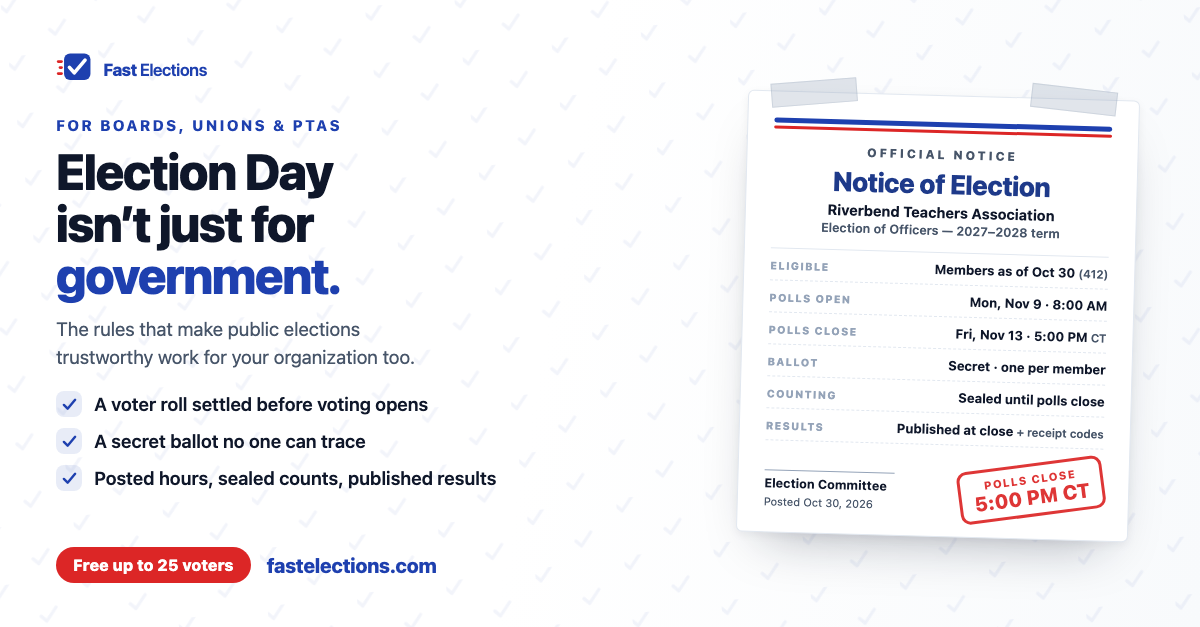
Every November, millions of Americans vote. Whatever you think of any race on the ballot, notice how much of the process nobody argues about. The rolls close before Election Day. The polls open and close at posted times. Nobody sees a count until voting ends. Your ballot doesn't have your name on it. And when the numbers come in, there is a published record that anyone can look at.
None of that happened by accident. Each of those rules exists because elections once failed without it — ballots that could be traced to voters, rolls padded after the fact, counts announced while people were still voting. Most American states adopted the secret ballot in the decades around 1890, after years of watching what open voting did to elections.
Now think about the last election your organization ran. The HOA board. The union local's officers. The PTA slate. The nonprofit's bylaw amendment. Those votes face every one of the same failure modes, just with fewer people. And most of them run with none of the rules.
Why it matters more than it looks
It's tempting to treat a small organization's election as a formality. Usually there's one candidate per seat, everyone knows each other, and the result surprises nobody.
The trouble is that the election you'll be judged on is the one that isn't a formality: the contested seat, the special assessment, the dues increase, the vote to merge. That's when a member asks who was allowed to vote, whether the ballot was really secret, and how anyone knows the count is right. If the honest answer is "we did it the way we always do," the board that wins governs with a little less authority than it should have. Members who doubt the process stop showing up — or start showing up angry.
The point of a good election isn't the winner. It's that the losing side accepts the result. Public elections are built around that goal. Organizational elections should be too.
Five rules worth borrowing
You don't need a county elections office. You need the principles behind it.
1. Settle the voter roll before voting opens. Public rolls close before Election Day so eligibility isn't decided in the moment. Do the same: pick an eligibility date, pull the roster from your membership records as of that date, resolve duplicates and shared email addresses, and keep a copy. Most disputes start with the list, not the ballot.
2. Make the ballot secret, not just confidential. A government ballot doesn't carry your name. Many organizational "anonymous" votes do — a survey tool collected an email to stop duplicate responses, and the anonymous setting just hides that column. A real secret ballot is one that can't be traced back to the voter by anyone, including whoever runs the election.
3. Post the hours and keep them. Polls open and close on a published schedule. Announce your voting window in advance, with a timezone, and close it when you said you would. "We kept it open a few extra days because turnout was low" sounds reasonable until someone notices which side benefited.
4. Don't count until the polls close. Election officials don't report counts while people are still voting. If anyone in your organization can watch a running tally — the administrator, the board, a candidate — they can react to it, and members will assume they did. Watch turnout, not results.
5. Publish the result and keep the record. Public results are posted, checked, and certified. Yours should at least be shared in writing, with turnout, and backed by a participation record you can produce if a member asks. Better still, give each voter a way to confirm their own ballot was counted.
What to skip
Borrowing the principles doesn't mean borrowing the bureaucracy. You don't need voter ID checks, a multi-week canvass, or members creating accounts and passwords. A password proves that someone remembers a password; it isn't what an election needs to know. Keep the parts that create trust and drop the parts that only create friction, because a process nobody uses isn't trustworthy either.
An Election Day checklist for your next vote
Bring this to the meeting where you plan your next election.
- Eligibility date chosen and recorded in the minutes.
- Roster pulled as of that date, with duplicates and shared addresses resolved.
- Your bylaws checked — they permit the voting method you plan to use, and the notice period is met. If it's unclear, ask your counsel or manager before, not after.
- Voting window announced in advance, with open and close times and a timezone.
- One ballot per eligible voter, issued individually. No open links, no group-chat polls.
- No one can see how anyone voted, including the people running the election.
- No one sees a running count while voting is open.
- Reminders planned for members who haven't voted yet, before the deadline, not after.
- Results shared in writing, with turnout, as soon as voting closes.
- Participation record kept with the minutes.
If you can check all ten, your election holds up to the same questions a public one does.
Where Fast Elections fits
We built Fast Elections so a volunteer can run an election that meets that list without building the machinery themselves.
You upload a roster and each voter gets their own unique, single-use voting link — no accounts, no passwords. Cast ballots carry no reference to the voter, and nothing in the product, for organizers or for us, connects a person to their choices. You set the open time, close time, and timezone; invitations go out at the start and the election closes itself at the end. While voting is open you see turnout, never the tally, and on paid tiers non-voters get automatic reminders before the deadline. When it closes, you can publish results at a link members open without signing in, alongside the list of receipt codes voters were shown when they cast — so each member can confirm their own ballot was counted. The participation record exports as a CSV for your minutes.
It doesn't replace your bylaws or your inspector of elections, and it has no proxy handling or quorum-rule engine. It gives the people who do those jobs a cleaner process and a better record.
If your organization has a vote coming up, you can build it in Fast Elections for free — up to 25 voters, no credit card — send yourself a test ballot, and see exactly what your voters will experience before paying anything: fastelections.com